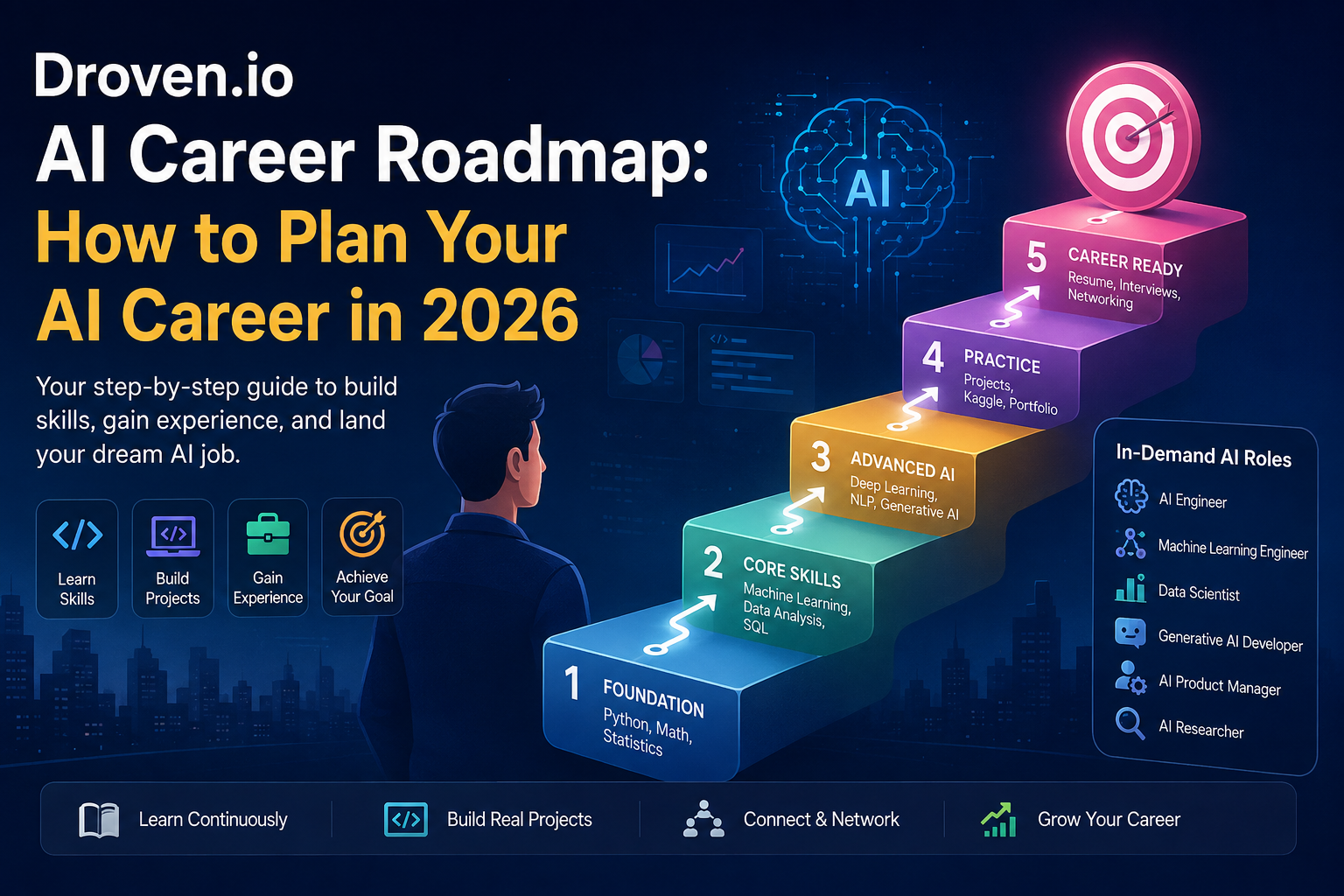
The Droven.io AI career roadmap can help learners identify useful AI skills, choose a career path, and plan the steps needed to build a career in artificial intelligence in 2026.
What Is the Droven.io AI Career Roadmap?
The Droven.io AI career roadmap is a structured way to plan an artificial intelligence career based on skills, learning goals, and career interests. A roadmap can help learners understand what to study first and which skills to develop next.
AI careers cover many different areas. Some roles focus on programming and machine learning, while others focus on data, AI products, automation, research, or business applications.
A clear roadmap is useful because AI is a broad field. Learning random tools without a clear goal can make the learning process difficult. A structured plan helps learners focus on skills that match their target role.
AI Career Paths to Consider in 2026
AI is used across software development, business, research, healthcare, finance, marketing, education, and many other industries. This creates several career paths for people with different technical backgrounds.
| AI Career Path | Main Skills | Suitable For |
|---|---|---|
| Machine Learning Engineer | Python, machine learning, algorithms, model development | Technical learners |
| AI Engineer | Python, AI frameworks, APIs, model integration | Software developers |
| Data Scientist | Statistics, Python, SQL, data analysis | Data-focused learners |
| AI Researcher | Mathematics, machine learning, research methods | Advanced technical learners |
| Generative AI Developer | LLMs, APIs, Python, AI applications | Developers building AI tools |
| AI Product Manager | Product strategy, AI concepts, communication | Product professionals |
| AI Automation Specialist | AI tools, workflows, APIs, automation | Business and technical users |
| Data Analyst | SQL, spreadsheets, statistics, visualization | Beginners in data careers |
The right path depends on existing skills, education, career goals, and the type of work a person wants to perform.
Skills to Learn for an AI Career
A strong AI career plan should include both technical and practical skills. The exact skills depend on the selected career path.
Python Programming
Python is widely used in AI and machine learning. It is useful for data processing, model development, automation, and AI application development.
Beginners should learn basic programming concepts before moving into advanced AI topics. Important areas include variables, functions, loops, data structures, modules, error handling, and object-oriented programming.
Mathematics and Statistics
Mathematics supports many important AI concepts. Learners interested in machine learning should understand basic linear algebra, probability, statistics, and calculus.
Not every AI job requires advanced mathematics. However, a good understanding of statistics and probability is valuable for working with data and evaluating models.
Data Skills
AI systems often depend on data. Data skills are therefore important for many AI roles.
Useful skills include:
- SQL
- Data cleaning
- Data analysis
- Data visualization
- Working with structured and unstructured data
- Basic statistics
- Data preparation
Learning how to inspect and prepare data can also help learners understand how AI models work in real applications.
Machine Learning
Machine learning is a core part of many AI careers. Learners should understand important concepts such as supervised learning, unsupervised learning, classification, regression, clustering, model evaluation, and overfitting.
Popular machine learning libraries can also be studied after the basic concepts are clear.
Generative AI
Generative AI is an important area of modern AI development. Learners may study large language models, text generation, image generation, embeddings, retrieval systems, and AI application development.
Understanding how AI models are used is more important than learning a long list of individual tools. Tools can change quickly, while fundamental concepts remain useful for longer.
A Practical AI Career Roadmap for Beginners
A beginner can follow a step-by-step learning plan instead of trying to study every AI topic at once.
| Stage | Main Focus | Key Goal |
|---|---|---|
| 1 | Programming basics | Build a foundation in Python |
| 2 | Mathematics and statistics | Understand essential AI concepts |
| 3 | Data skills | Learn to work with and analyze data |
| 4 | Machine learning | Understand common ML methods |
| 5 | Generative AI | Learn modern AI application concepts |
| 6 | Projects | Apply skills to practical problems |
| 7 | Portfolio | Show completed work |
| 8 | Career preparation | Prepare for jobs, internships, or freelance work |
This approach allows learners to build skills gradually. Each stage should be completed with practical exercises before moving to more advanced subjects.
How to Build an AI Portfolio
A portfolio gives employers and clients evidence of practical ability. Certificates can show that a course was completed, but projects can demonstrate how skills are applied.
AI projects should be relevant to the target career. A machine learning candidate can build prediction or classification projects. A generative AI developer can build applications that use language models or retrieval systems.
Good portfolio projects should explain:
- The problem being solved
- The data or information used
- The tools and technologies used
- The development process
- The results
- Any limitations
- Possible improvements
Projects should also be documented clearly. A simple project description can make technical work easier for recruiters and other professionals to understand.
How to Choose the Right AI Career
Choosing an AI career should start with an assessment of current skills and professional goals.
People who enjoy programming may consider AI engineering or machine learning engineering. Those who prefer data analysis may find data science or data analytics more suitable. Professionals with business experience may explore AI product management or AI automation.
The following questions can help:
- Do you enjoy programming?
- Are you comfortable working with mathematics and statistics?
- Do you prefer working with data?
- Do you want to build AI applications?
- Do you prefer technical or business-focused work?
- What type of industry interests you?
- How much time can you spend learning each week?
The answers can help narrow the number of possible career paths.
AI Career Roadmap for Experienced Professionals
People who already work in technology, business, data, or another professional field do not always need to start from the beginning.
A software developer may focus on machine learning, AI APIs, model integration, and AI application development. A data analyst may build skills in machine learning and advanced statistics. A product manager may focus on AI product development, model capabilities, data requirements, and responsible AI practices.
Existing professional skills can provide a useful foundation. The goal is to add AI knowledge to those skills and create a clear career direction.
How to Keep an AI Career Plan Current
AI changes quickly, so a career roadmap should be reviewed regularly. The core principles of programming, statistics, data analysis, and machine learning can remain useful for years, while specific tools and platforms may change.
Learners should track developments in areas that directly relate to their target role. They should also review job descriptions to identify skills commonly requested by employers.
A practical review can be done every few months. During the review, check:
- Which skills have been completed
- Which skills still need practice
- Which technologies are becoming important
- Which portfolio projects should be improved
- Which job requirements appear frequently
- Which areas are no longer relevant to the target career
This keeps the AI career roadmap focused without requiring constant changes.
AI Career Roadmap: Skills vs Tools
A common mistake is to focus too heavily on individual AI tools. Tools are useful, but durable skills are more valuable for a long-term career.
| Skills | Tools and Technologies |
|---|---|
| Programming | Python libraries and development platforms |
| Machine learning | ML frameworks |
| Data analysis | SQL and analytics software |
| Model evaluation | Evaluation and monitoring tools |
| AI application development | AI APIs and platforms |
| Problem solving | Automation and development tools |
Tools can change as new technologies appear. Strong fundamentals make it easier to learn new tools when they become relevant.
Preparing for AI Jobs in 2026
Job preparation should begin before completing the entire roadmap. Learners can start reviewing job descriptions while building their skills.
Common requirements vary by role, but many technical AI positions may ask for programming, data handling, machine learning knowledge, software development skills, or experience with AI systems.
A strong application should clearly connect skills with evidence. For example, instead of only listing Python on a resume, a candidate can describe a project where Python was used to process data, train a model, or build an AI application.
Candidates should also maintain a professional portfolio and keep project documentation clear and accurate.
Responsible AI Skills
Responsible AI is another important part of an AI career. Professionals should understand that AI systems can produce inaccurate, biased, or unsafe results.
Basic responsible AI knowledge includes:
- Data privacy
- Security
- Bias and fairness
- Model limitations
- Transparency
- Human oversight
- Proper evaluation
These topics are relevant because AI systems are increasingly used in real business and professional environments.
A Simple Weekly AI Learning Plan
A consistent schedule can make an AI career roadmap easier to follow. Learners can divide their weekly time between learning, practice, and projects.
| Activity | Suggested Focus |
|---|---|
| Learning | Study one core concept |
| Practice | Complete coding or data exercises |
| Project work | Apply the concept to a real project |
| Review | Check mistakes and improve understanding |
| Career work | Update portfolio or review job requirements |
The exact schedule can be adjusted according to the learner’s available time. Consistency is more useful than trying to study too many subjects at once.
Tracking Progress on an AI Career Roadmap
Progress should be measured by skills and practical results rather than the number of courses completed.
A useful tracking system can include four levels:
- Learning: Understand the basic concept.
- Practice: Use the concept in exercises.
- Application: Use the skill in a project.
- Proof: Document the project and add it to the portfolio.
This system provides a clearer view of career readiness. It also helps identify areas that require more practice before moving forward.
About the Author



1 thought on “Droven.io AI Career Roadmap: How to Plan Your AI Career in 2026”